



Petrol & Diesel Prices Jump Rs.55 in Pakistan – What Every Driver Needs to Know
If you filled your tank yesterday, you already know. If you haven’t, here is the full picture.
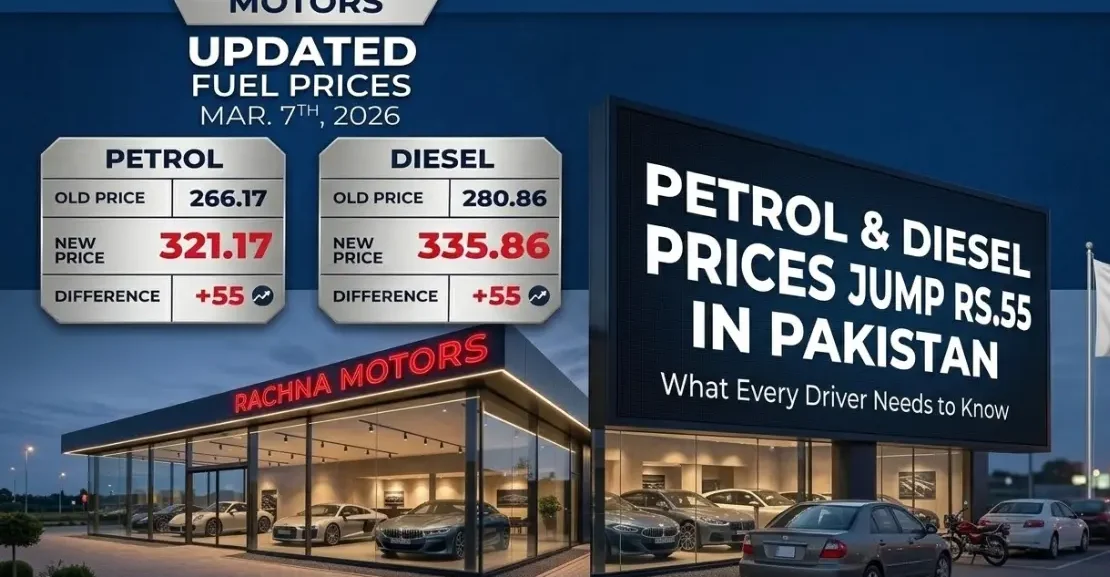
The federal government raised petrol and diesel prices by Rs.55 per litre each, effective from midnight March 7, 2026. Petrol now stands at Rs.321.17 per litre and high-speed diesel at Rs.335.86 per litre.
This is the steepest single-day fuel price adjustment in recent Pakistani history. And unlike routine fortnightly revisions, this one was driven by something far bigger, a full-scale geopolitical crisis in the Middle East that has disrupted global oil supplies overnight.
Here is everything you need to know: what changed, why it happened, how Pakistan is responding, and what it means for your daily driving costs.
New Petrol & Diesel Prices – March 7, 2026
The new prices, effective from midnight March 7, 2026, take petrol from Rs.266.17 to Rs.321.17 per litre and high-speed diesel from Rs.280.86 to Rs.335.86 per litre.
| Fuel Type | Previous Price | New Price | Increase |
|---|---|---|---|
| Petrol (Motor Spirit) | Rs.266.17/litre | Rs.321.17/litre | +Rs.55 |
| High-Speed Diesel (HSD) | Rs.280.86/litre | Rs.335.86/litre | +Rs.55 |
This follows another increase just days earlier. On March 1, 2026, the government had already raised petrol by Rs.8 per litre and diesel by Rs.5.16 per litre, taking petrol above Rs.266 and diesel above Rs.280. That means within one week, Pakistani drivers have absorbed a combined fuel price increase of over Rs.63 per litre.
Who Announced It and How?
The announcement was made by Petroleum Minister Ali Pervaiz Malik in a press conference alongside Deputy Prime Minister Ishaq Dar and Finance Minister Muhammad Aurangzeb.
This was announced during a late-night press conference on Friday, March 6, 2026, with the revised prices taking effect immediately from Saturday.
This was not a routine pricing review. It was an emergency decision, taken after a high-level government committee constituted by Prime Minister Shehbaz Sharif had been monitoring the evolving situation daily for several days.
Why Did Petrol Prices Jump Rs.55? – The Root Cause
To understand the scale of this increase, you need to understand what happened in the Middle East.
On February 28, 2026, the United States and Israel initiated coordinated airstrikes on Iran under Operation Epic Fury, targeting military facilities, nuclear sites, and leadership. In response, Iran’s Islamic Revolutionary Guard Corps (IRGC) effectively closed the Strait of Hormuz, a critical global maritime chokepoint through which roughly 20% of the world’s daily oil supply passes.
Shipping through the strait, which carries one-fifth of the oil consumed globally as well as large quantities of gas, ground to a near halt amid Iranian attacks on oil tankers in the region. At least five tankers were damaged, two personnel killed, and about 150 ships stranded around the strait.
The impact on global oil prices was immediate and severe. Deputy Prime Minister Dar noted during the press conference that global oil prices had surged by up to 50% following rising tensions in the Middle East.
For Pakistan, a country that imports nearly all of its petroleum, this translated directly into a massive increase in the cost of every litre of fuel entering the country.
How Does This Affect Pakistan Specifically?
Pakistan is particularly exposed to Middle East energy disruptions.
Pakistan consumes approximately 450,000 barrels of crude oil daily, with 85% of these imports originating from Gulf producers, creating a concentrated vulnerability through the Strait of Hormuz, which handles roughly 21% of global petroleum liquids transit.
Pakistan and Bangladesh have limited storage and procurement flexibility, meaning disruption would likely trigger fast demand destruction rather than aggressive spot bidding for alternative supplies.
Beyond crude oil, the cost of getting fuel to Pakistan has also exploded. Insurance premiums for oil cargoes have escalated from approximately $30,000 per vessel to nearly $400,000. Freight rates have surged past $4 million per shipment, compared to roughly $900,000 before the onset of the crisis.
These extraordinary costs are being passed directly to Pakistani consumers.
Pakistan’s Fuel Stocks – Should You Panic?
Short answer: No. But the situation requires close monitoring.
Pakistan holds sufficient oil stocks to meet around 28 days of national consumption, according to OGRA officials, with pre-emptive imports in recent months helping build surplus reserves of petrol and diesel above the mandatory 21-day requirement.
However, two crude oil consignments bound for Pakistan have been delayed due to the Strait of Hormuz closure.
To address the supply chain disruption, Pakistan sought an alternative oil supply route through Saudi Arabia’s Red Sea port of Yanbu, bypassing the closed Strait. Saudi authorities have assured Pakistan that oil supplies can be facilitated through this alternative route.
The Finance Minister urged calm at the press conference, confirming that Pakistan has sufficient fuel reserves and is not facing an immediate shortage.
What Is the Government Doing Next?
Several emergency measures are now in motion:
The petroleum minister confirmed the government will review fuel prices on a weekly basis going forward , a shift from the previous fortnightly review cycle, and will reduce prices promptly once the situation improves.
The government also adjusted the petroleum development levy: the PDL on petrol was increased from Rs.84.40 to Rs.105 per litre, while the levy on high-speed diesel was reduced from Rs.76.21 to Rs.55 per litre.
Additionally, Pakistan has begun preparing emergency energy conservation measures, including work-from-home arrangements for employees and online classes for schools and colleges, aimed at reducing daily commuting and lowering fuel consumption.
PM Shehbaz Sharif also ordered an immediate crackdown on petrol hoarding, a critical step given that existing petroleum stocks reportedly purchased nearly 24 days earlier at lower rates may now be sold at the revised higher prices.
What This Means for Your Daily Costs
The Rs.55 per litre jump is not just a pump price change, it ripples through the entire economy.
For private car owners: A full 40-litre tank now costs Rs.2,200 more than it did last week. Monthly fuel costs for an average daily commuter will increase by Rs.4,000 to Rs.7,000 depending on usage.
For motorcyclists: A 10-litre fill-up costs Rs.550 more. For the millions of Pakistanis who rely on motorcycles as their primary transport, this is a significant household budget impact.
For freight and transport: Diesel drives Pakistan’s entire supply chain, trucks, buses, agricultural machinery, generators. Higher diesel costs mean higher prices for food, goods, and intercity travel. Expect transport fares and commodity prices to increase in the coming days.
For hybrid and fuel-efficient car owners: This hike makes the fuel economy advantage of hybrid vehicles like the Haval H6 HEV, Hyundai Palisade, and similar models significantly more valuable. A vehicle delivering 15 km/L now saves substantially more per kilometre compared to a car delivering 10 km/L.
Price History – How We Got Here
| Date | Petrol Price | Diesel Price | Change |
|---|---|---|---|
| February 28, 2026 | Rs.258.17/litre | Rs.275.70/litre | Baseline |
| March 1, 2026 | Rs.266.17/litre | Rs.280.86/litre | +Rs.8 / +Rs.5.16 |
| March 7, 2026 | Rs.321.17/litre | Rs.335.86/litre | +Rs.55 / +Rs.55 |
FAQs
What is the current petrol price in Pakistan today?
As of March 7, 2026, petrol is priced at Rs.321.17 per litre and high-speed diesel at Rs.335.86 per litre, following a Rs.55 per litre increase announced on March 6.
Why did petrol prices increase by Rs.55 in Pakistan?
The increase is driven by the closure of the Strait of Hormuz following the US-Israel military conflict with Iran, which disrupted 20% of global oil supply and caused a sharp spike in international crude prices and shipping costs.
Will petrol prices increase further in Pakistan?
The government has shifted to weekly price reviews and officials have warned that further adjustments cannot be ruled out if the Middle East situation worsens. Prices will be reduced promptly once international rates stabilise.
Is there a petrol shortage in Pakistan right now?
As of March 7, 2026, Pakistan has approximately 28 days of fuel reserves, above the mandatory 21-day requirement. There is no immediate shortage, though two crude oil shipments have been delayed due to the Strait of Hormuz closure.
Final Thoughts
Pakistan’s Rs.55 per litre fuel price hike is the direct result of an extraordinary global event, a military conflict that has effectively shut down one of the world’s most critical oil shipping routes overnight.
For drivers, the immediate advice is practical: avoid panic buying, plan fuel stops efficiently, and if you own a fuel-efficient or hybrid vehicle, it is now doing significantly more work for your household budget than it was last week.
At Rachna Motors, we understand that fuel costs directly affect the total cost of owning a vehicle. If you are considering switching to a more fuel-efficient car, browse our current inventory for verified used and new options in Lahore. Our team at Faisal Town can help you find a vehicle that makes more sense at Rs.321 per litre.